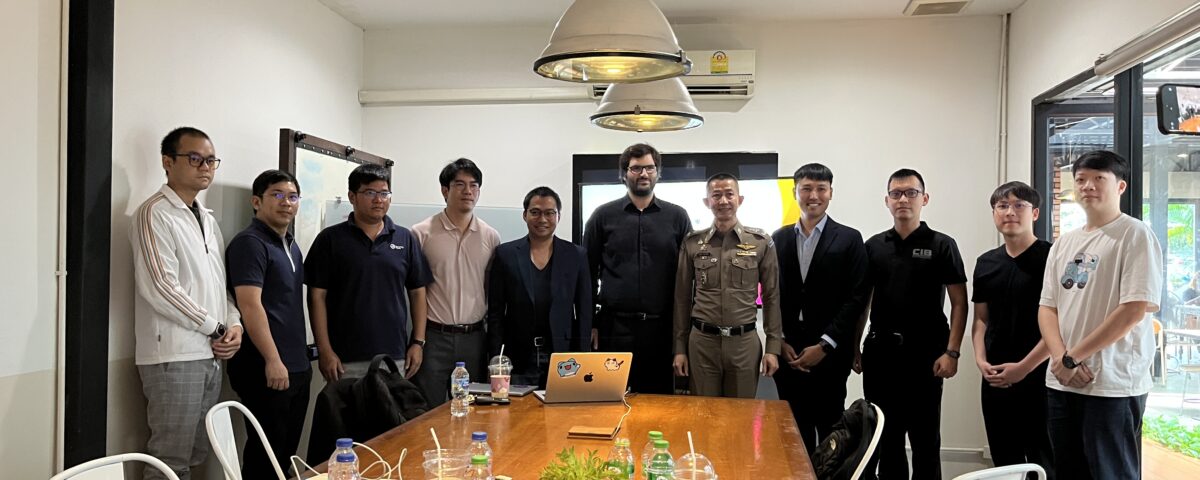
On Friday, July 25, 2025, The Center for Crime Science, in collaboration with the U.S. Embassy in Thailand,
hosted a special Crime Talk lecture titled:
“Tech-Driven Policing: U.S. Perspectives on AI and Public Safety”
Delivered by Ms. Ali Crawford,
Senior Research Analyst from Georgetown University’s Center for Security and Emerging Technology (CSET)
at Computer Room, 100-Year Building (Library), Royal Police Cadet Academy

The lecture focused on the U.S. Government’s AI Action Plan announced in 2025, aiming to enhance the country's AI capabilities across all dimensions. The plan is structured around three main pillars:
1. Accelerating AI Innovation – including investments in AI infrastructure and reinforcing the U.S. role in international cooperation. Ms. Crawford explained that the U.S. is promoting regulatory sandboxes to allow the private sector to safely test emerging technologies. At the same time, AI Centers of Excellence are being established to create shared standards and adaptive regulatory frameworks.
2. Infrastructure Development – with a strong emphasis on investing in the semiconductor industry, clean energy sources such as geothermal and nuclear fusion, and cybersecurity enhancements for the nation’s critical infrastructure.
3. International Cooperation – by promoting U.S. AI standards globally and establishing international threat intelligence exchange centers to counter emerging digital threats.
The session also delved into legal dimensions, particularly concerning synthetic media and AI-generated images that may infringe on personal privacy.
Ms. Crawford cited the “Take It Down Act”, the first comprehensive U.S. law requiring online platforms to remove violative content within 48 hours and prohibiting the dissemination of explicit or misleading AI-generated images, even if prior consent was given by the subject.

Ms. Crawford emphasized that sustainable AI development depends on advancing both human capital and education systems. As such, the U.S. government supports initiatives to build AI literacy from youth, funded by the National Science Foundation. Additionally, skills-based hiring practices and tax incentives for companies investing in employee AI upskilling are actively being encouraged.
This lecture marks a significant step for the Center in embracing data-driven and tech-enabled policing, while showcasing the potential of international academic collaboration in addressing transnational crime and digital-age threats.

Special thanks to the U.S. Embassy, the distinguished speaker, and all supporting agencies for contributing to the success of this event.
Stay tuned for more insights and academic content at:
facebook : Center for Crime Science
#RPCA #CrimeScience #HubOfKnowledge
#CrimeScience #CenterOfKnowledge