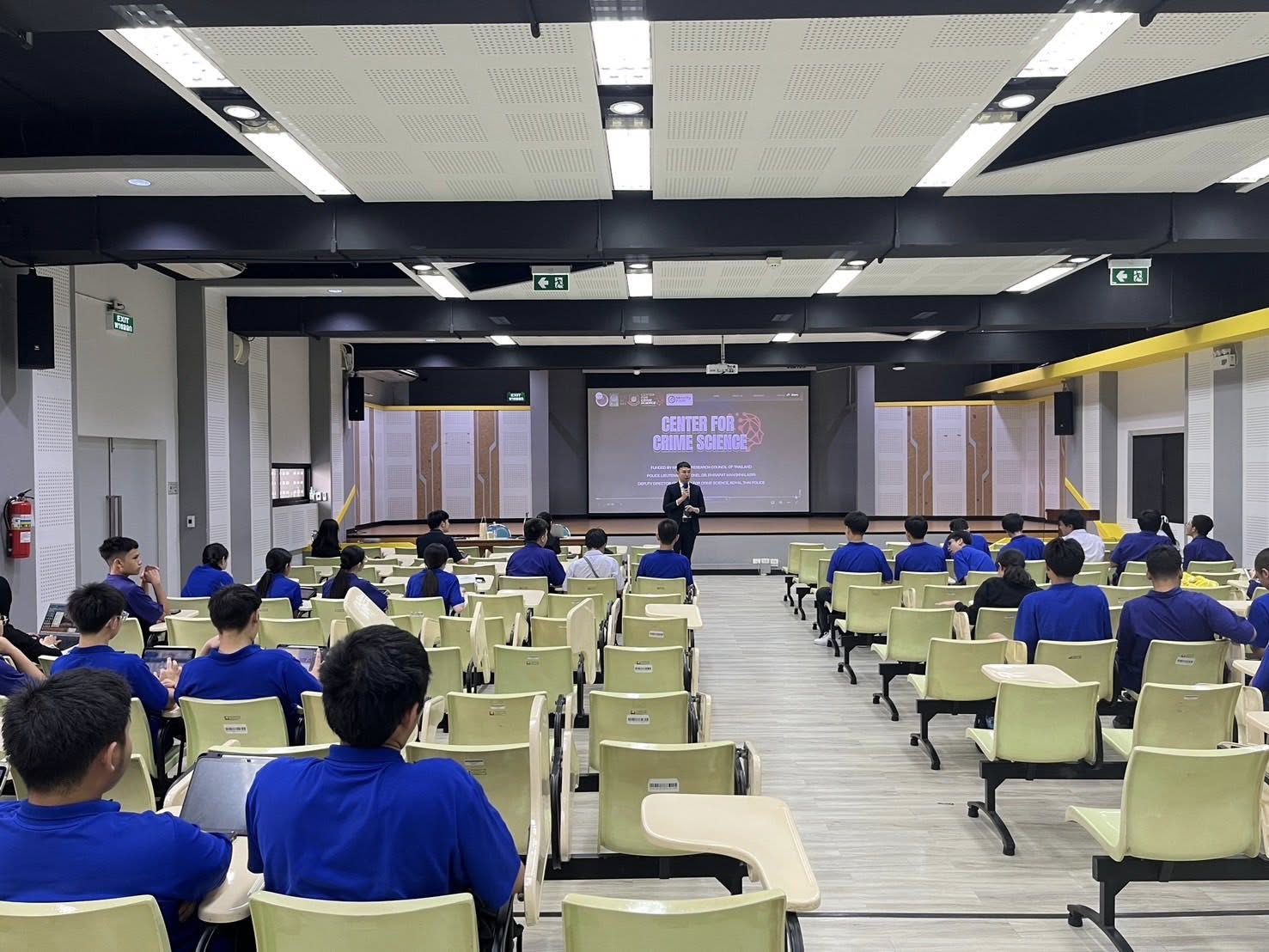
On Tuesday, 10 February 2026, at Mahidol Wittayanusorn School,
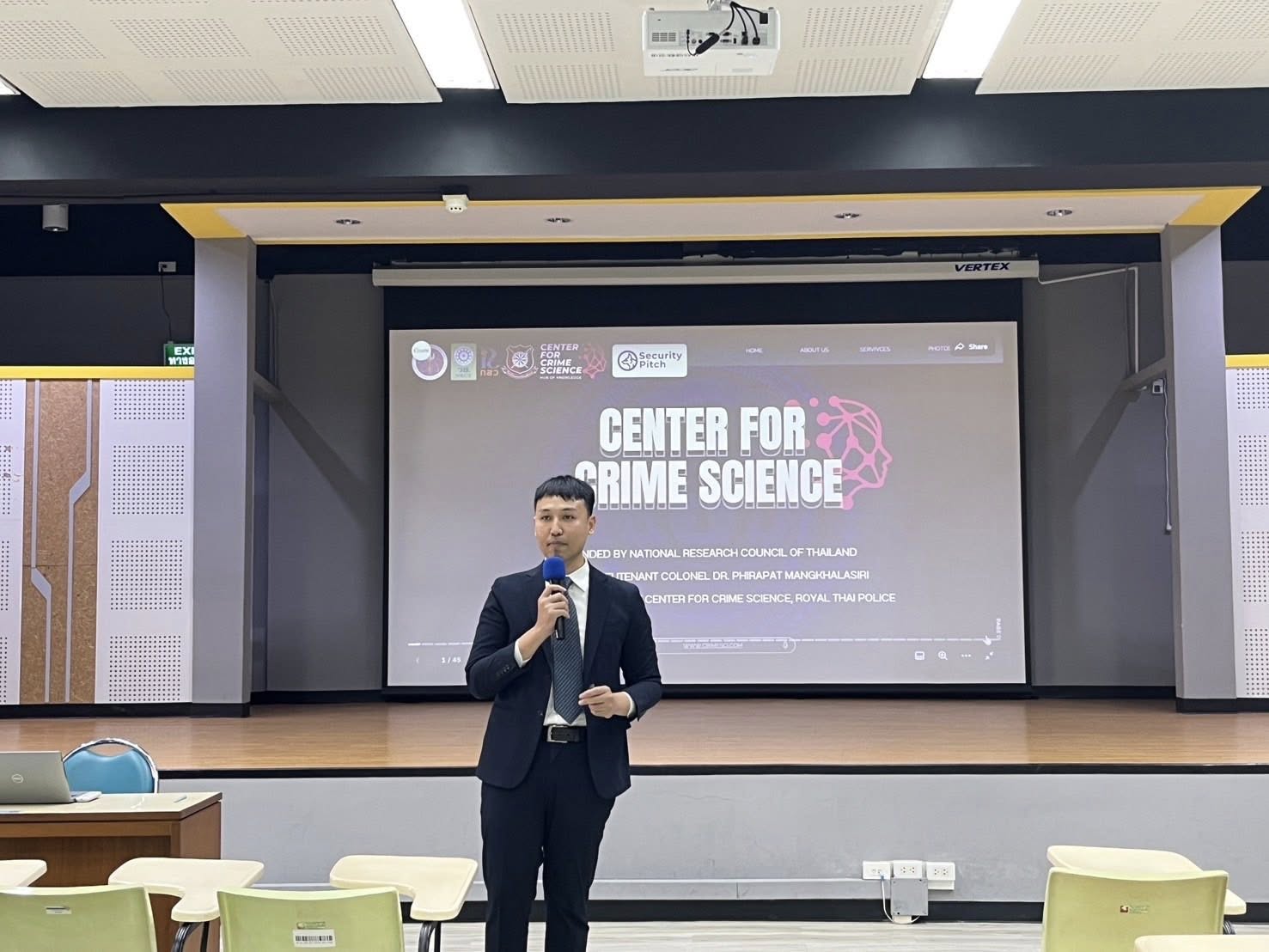
Pol. Lt. Col. Dr. Peeraphat Mangkhalasiri,
Deputy Director of the Center for Crime Science,
was honored to deliver a special lecture on the topic:
“The Use of Advanced Technologies (AI and Innovation) in Crime Prevention in the Digital Age”
In an era where crime evolves alongside technology, prevention can no longer rely solely on patrols or post-incident arrests. It requires the systematic and precise application of data, research, and innovation to effectively manage and reduce crime.
Crime Science is an applied discipline that integrates knowledge from geography, social sciences, economics, and law to understand the causes and patterns of crime and to design targeted, proactive prevention measures.
AI Technology and Intelligent Surveillance
The development of AI Police Cyborg 1.0, an intelligent police robot, was introduced. It is equipped with 360-degree surveillance cameras, facial recognition technology, and real-time suspicious behavior detection systems. The system integrates data from CCTV cameras and drones into a centralized Command and Control Operation Center, enhancing monitoring capabilities and enabling timely responses to incidents.
Data-Driven Investigation
AI is also applied in online case management, significantly reducing case processing time. It supports criminal network analysis through a 3D Knowledge Graph, allowing authorities to identify crime trends and design targeted preventive measures—such as alert systems for emerging scam patterns.

At the same time, Forensics AI plays a critical role in analyzing financial trails and digital transactions, enabling precise tracking and expansion of criminal network investigations.
International Standards and Cross-Border Cooperation
Operations are guided by the principles of Evidence-Based Policing and Problem-Oriented Policing, alongside strengthened international cooperation to address transnational crimes such as call center scam networks and cross-border money laundering operations.
The lecture atmosphere was highly engaging. Students showed great interest, actively asking questions, exchanging perspectives, and reflecting on the future role of technology in law enforcement. Their participation demonstrated strong awareness of digital security issues and a growing interest in the fields of technology and justice.
Crime prevention in the digital age is therefore not merely about “arresting offenders,”
but about leveraging data, technology, and multi-sector collaboration
to sustainably reduce opportunities for crime.