What Maggots Can Tell Us About Time of Death, and What They Cannot
When a body is found weeks or months after death, the first question an investigation asks is how long ago it happened, and the next is what is left to read that time from.
One answer is insects. The field that does this is called forensic entomology.
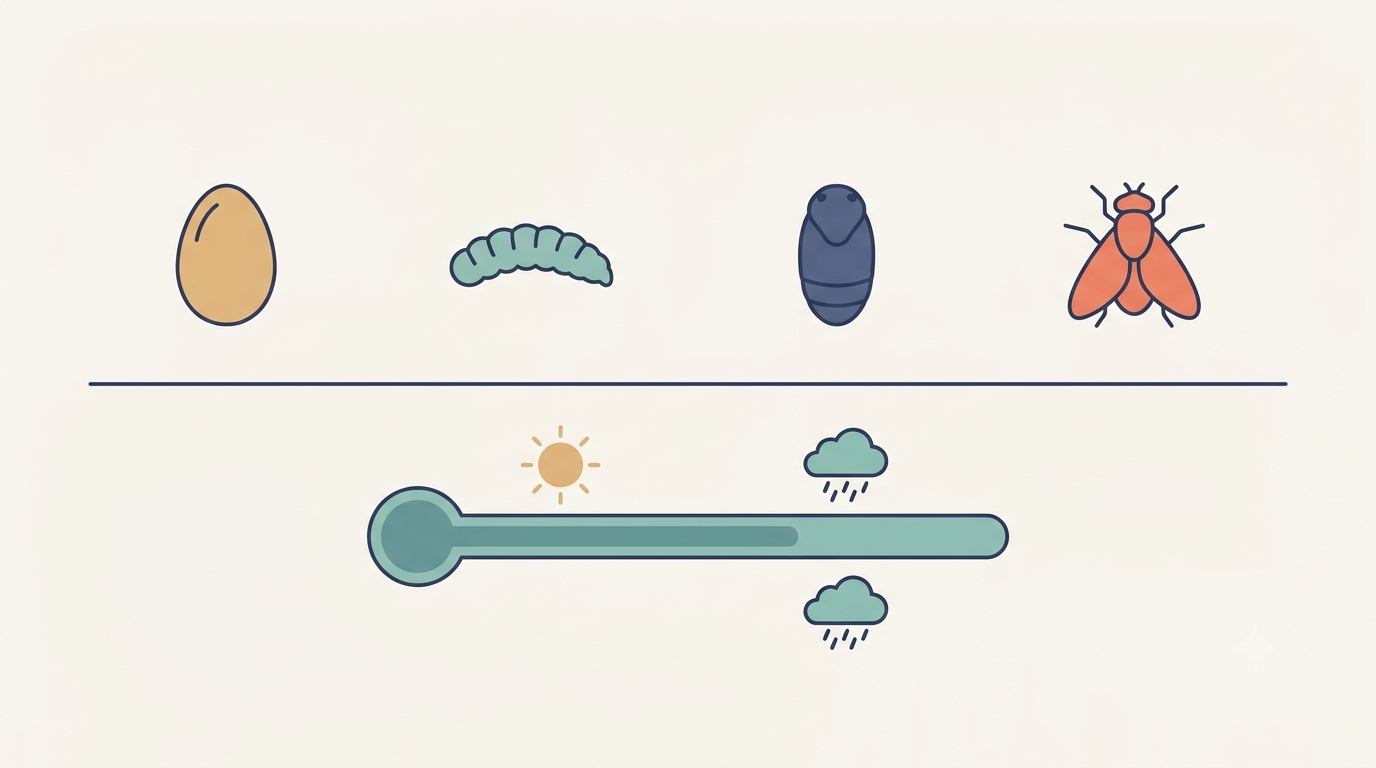
The principle is simpler than it sounds. Blow flies are the first insects to colonise a corpse, within a few hours after death, and their larvae develop on a schedule that can be measured, with developmental times that are specific to each species, even between species that are closely related.
To picture it: if we know how tall a child of a given age usually is and how many teeth they have, we can estimate that child's age from their size. Maggots work the same way, except that their growth schedule is counted in hours rather than years.
"A maggot does not tell you the hour the heart stopped. It tells you the death is at least this old."
Source: https://pmc.ncbi.nlm.nih.gov/articles/PMC6315464/
Thailand's First Documented Case
A paper published in the Journal of Medical Entomology in 2001 recorded the first forensic entomology case formally documented in Thailand.
The mummified body of a 32-year-old man was found in a forested habitat, with the larvae of six species of flies present at the time of discovery: Hydrotaea spinigera, Piophila casei, Megaselia scalaris, a species of the genus Sagus, and two unidentified flesh fly species.
The detail worth reading closely is that the estimated postmortem interval of 3 to 6 months came from the presence and age of the larvae of only three of those species, namely Piophila casei, Megaselia scalaris and Hydrotaea spinigera, rather than from all six together.
Something else is notable. None of the insects found in this case were blow flies, the group that reaches remains before any other. Those found were later arrivals that come once remains have dried out. That composition is what fits a timescale of months rather than days.
Source: https://pubmed.ncbi.nlm.nih.gov/11580050/
What Insects Can and Cannot Say
The term entomologists actually use is the minimum postmortem interval, not the time of death.
Thai research published in the journal Insects in 2018 defines it precisely as the window of time between the day when insects first colonised the body and the day the corpse is found.
Put simply, the figure produced is a floor. It means the death is at least this old. How long the person had been dead before the first insect arrived is a question the insect evidence does not answer.
Picture it this way. If a body was kept somewhere insects could not reach and was only later moved outdoors, the insect clock only starts running at the point it went outside. The resulting figure will fall short of the true interval since death.
Given that definition, a figure derived from insect evidence answers only for the lower bound of the window, and has to be read alongside other lines of evidence.
Source: https://pmc.ncbi.nlm.nih.gov/articles/PMC6315464/
Why Getting the Species Right Matters So Much
Developmental times are species-specific, even between species that look almost identical. Identify the species wrongly and the calculated age is wrong with it.
The difficulty is that identification by external appearance has limits, because the available taxonomic keys do not cover every developmental stage, and damaged specimens often lack the very features needed to tell species apart.
Thai researchers therefore turned to DNA sequences. The 2018 study tested the mitochondrial genes COI at 1247 base pairs and COII at 635 base pairs against 16 species of forensically relevant blow flies found in Thailand, covering the genera Chrysomya, Lucilia, Hemipyrellia and Hypopygiopsis.
Under the Best Match criterion, identification was correct 100 percent of the time for both genes. Under Best Close Match the figures were 98.24 percent for COI and 98.01 percent for COII, and under All Species Barcodes they were 94.73 percent and 94.05 percent respectively. Importantly, no incorrect identification was observed under any of the three criteria for either gene.
Source: https://pmc.ncbi.nlm.nih.gov/articles/PMC6315464/
Heat Drives Everything
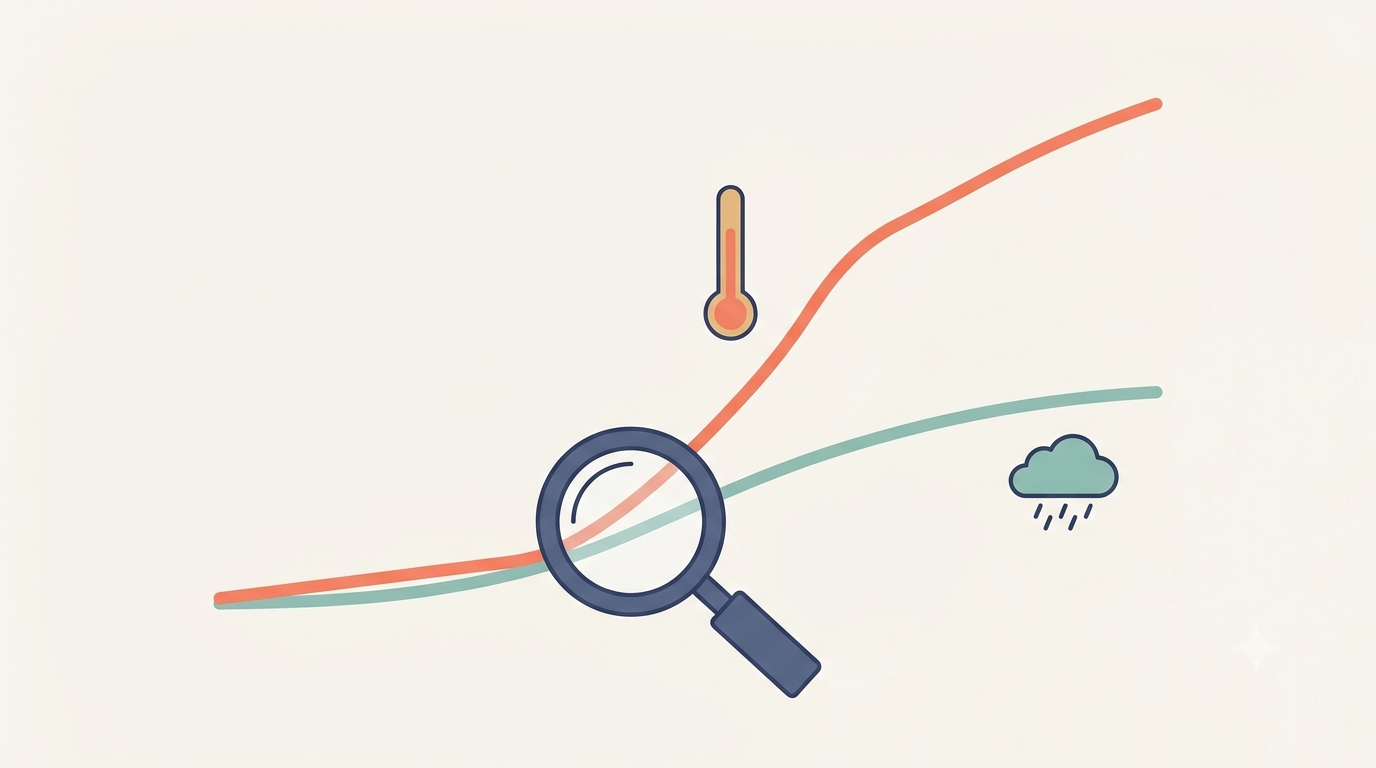
Insects are cold-blooded. The warmer it is, the faster the larvae grow. The growth schedule is therefore not a fixed value but one that shifts with temperature.
A study collecting data in Chiang Mai province between 2000 and 2001, under natural ambient temperature and a natural light-dark photoperiod, found that larvae of Chrysomya megacephala developed most rapidly in April, with pupariation beginning at 84 hours at an average temperature of 31.4 degrees Celsius, and grew more slowly in the rainy season and in winter.
Chrysomya rufifacies developed rapidly in the summer, with a pupariation period as short as 96 hours in June, at an average temperature of 27.4 degrees Celsius.
These two sets of figures explain why a temperature record from the scene is evidence every bit as important as the maggots themselves. Two larvae of identical size can differ greatly in age if one grew through a scorching April and the other through the rainy season.
Source: https://pubmed.ncbi.nlm.nih.gov/18264799/
Lessons for Thailand
This subject differs from many we have covered, in that Thailand already has its own reference base: growth schedules measured in genuine Thai conditions in Chiang Mai, and a DNA sequence library for 16 blow fly species found in the country.
The reason measuring it locally matters so much is that once growth depends on temperature, a value measured in one climate cannot stand in for another. Lifting figures from a foreign textbook and applying them to a body in Thailand risks error from the outset.
What practitioners can do immediately is collect insect specimens and record temperature from the first day a body is found, because temperature data that was never recorded can never be recovered later.
For the general reader there are two practical points. First, larvae on a body are scientific evidence rather than filth to be cleared away before officials arrive, so leaving a scene undisturbed is a way of preserving that evidence. Second, do not trust the television version in which a pathologist glances at a body and names the hour of death. What science can genuinely offer is a checkable window of time, together with an account of where that number came from, which is worth far more in court than a precision that cannot be defended.
References
Sontigun, N., Sukontason, K. L., Amendt, J., Zajac, B. K., Zehner, R., Sukontason, K., Chareonviriyaphap, T., & Wannasan, A. (2018). Molecular analysis of forensically important blow flies in Thailand. Insects, 9(4), 159. https://pmc.ncbi.nlm.nih.gov/articles/PMC6315464/
Sukontason, K., Sukontason, K. L., Vichairat, K., Piangjai, S., Lertthamnongtham, S., Vogtsberger, R. C., & Olson, J. K. (2001). The first documented forensic entomology case in Thailand. Journal of Medical Entomology, 38(5), 746-748. https://pubmed.ncbi.nlm.nih.gov/11580050/
Sukontason, K., Piangjai, S., Siriwattanarungsee, S., & Sukontason, K. L. (2008). Morphology and developmental rate of blowflies Chrysomya megacephala and Chrysomya rufifacies in Thailand: Application in forensic entomology. Parasitology Research, 102(6), 1207-1216. https://pubmed.ncbi.nlm.nih.gov/18264799/
Good knowledge should not stay in the library. It should be used to build a safer world.
Follow us at www.crimesci.com
Contact info@crimesci.com
#HubofKnowledge #CenterforCrimeScience #CrimeScienceWeekly
#วิทยาการอาชญากรรม #นิติกีฏวิทยา #ForensicEntomology #นิติวิทยาศาสตร์