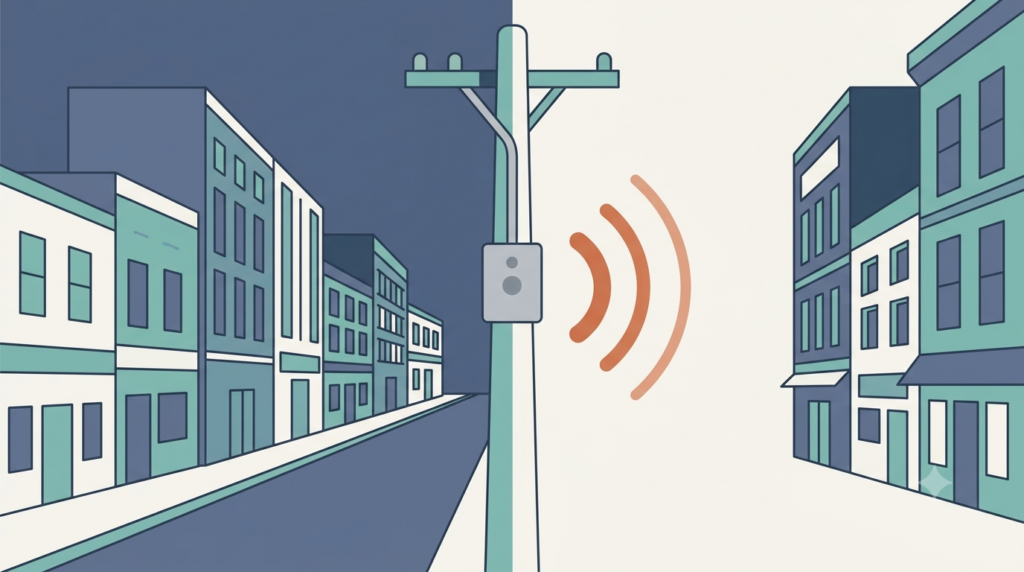
Street Lighting and CCTV: How Much Do the Two Most Popular Measures Actually Achieve?
When a community feels unsafe, the first two things proposed are almost always the same: better lighting, and more CCTV cameras.
Both belong to an idea known as CPTED, crime prevention through environmental design, which holds that it is possible to use the built urban form to reduce opportunities for crime.
Notably, the idea does not rest on four principles, as it is often described. A review in the Journal of Planning Literature records that CPTED is based on seven key strategies: territorial reinforcement, surveillance, image, access control, legitimate activity support, target hardening, and geographical juxtaposition, meaning the surrounding environment.
The term was coined by C. Ray Jeffery in 1971, building on foundations laid by Jane Jacobs and Oscar Newman.
"The question is not whether the idea sounds reasonable, but what it delivers when measured: by how many per cent does crime fall, and which kinds of crime fall at all?"
Source: https://prohic.nl/wp-content/uploads/2021/02/166-15feb2021-CPTEDReview.pdf
Lighting Works, But Not on Everything
Before the numbers, a word about what kind of study these are.
A systematic review gathers every study ever done on a question that meets a set of stated criteria, and pools their results into a single calculation. This is more reliable than picking one study with an attractive result, because a single study can produce such a result by chance.
The review of street lighting published in 2022 covers almost half a century of research, assembling 21 evaluations from four countries, the United States, the United Kingdom, Brazil and South Korea, spanning 1974 to 2021.
These studies work by comparing an area where lighting was improved against another area of similar character where it was not, known as a comparison area. A comparison area is necessary because crime rises and falls on its own with the seasons and with the economy. Looking only at the lit area would leave no way to tell whether a fall was caused by the lighting or by something else entirely.
Pooling the results of 17 studies, crime fell by 14 per cent in the treated areas compared with the comparison areas.
Split by crime type, the picture changes. Property crime such as theft and burglary fell significantly. Violent crime such as assault did not fall significantly at all.
Not statistically significant here does not mean the figure was zero. It means the difference measured was too small to separate from the ordinary fluctuation in crime numbers. In plain terms, it cannot yet be concluded that there was a real effect.
Source: https://prohic.nl/wp-content/uploads/2022/05/389-StreetLightingEffectivenessPreventingCrimeSystematicReview.pdf
The Strangest Finding in the Lighting Research
The reviewers divided the studies into two groups according to how they counted. The first group counted crime during both day and night. The second counted night-time crime only.
The result runs entirely against expectation. In the group counting day and night, crime fell by 18 per cent. In the night-only group it fell by just 3 per cent, too small to conclude there was a real effect.
Consider why that is strange. If lighting works by making things easier to see, the effect should be clearest at night, because daylight is already there and additional street lamps change nothing during the day.
Yet the data says the opposite: including daytime in the count made the figure better, which means daytime crime fell as well, in hours when the lights were not even on.
If daytime crime fell too, then whatever produced the fall is probably not the light itself, but something that arrived along with the installation.
The reviewers therefore suggest an explanation: that authorities coming in to fit new lighting may make residents feel their area is cared for and worth taking pride in, so they watch over it more attentively throughout the whole day. That explanation covers daytime and night-time alike.
Source: https://prohic.nl/wp-content/uploads/2022/05/389-StreetLightingEffectivenessPreventingCrimeSystematicReview.pdf
The Other Explanation That Cannot Be Ruled Out
What makes this review trustworthy is that the reviewers do not stop at the explanation they prefer. They warn that another explanation cannot be excluded, and it reverses the order of cause and effect entirely.
The first explanation runs: the lights go in, the community takes pride and watches over the place, and crime falls.
The second runs: communities that are already strong and already care about their surroundings are the ones that organise, lobby and get the lighting installed, and such communities already have lower crime for other reasons. If that is what happened, the lighting did not cause the fall in crime. It was a by-product of a community that was already strong.
The reviewers state that, based on most of the studies included in the review, it is difficult to exclude the second explanation.
Another limitation they consider more pressing concerns displacement, meaning cases where crime does not actually disappear but moves to the next street along, which is still dark. Where that happens, the figures for the lit area look better while the city as a whole is no better off at all.
The difficulty is that only three of the eight newer studies examined this, which leaves it unanswered whether the crime that fell truly went away, or simply moved.
Source: https://prohic.nl/wp-content/uploads/2022/05/389-StreetLightingEffectivenessPreventingCrimeSystematicReview.pdf
CCTV Works in Certain Places, Not Everywhere
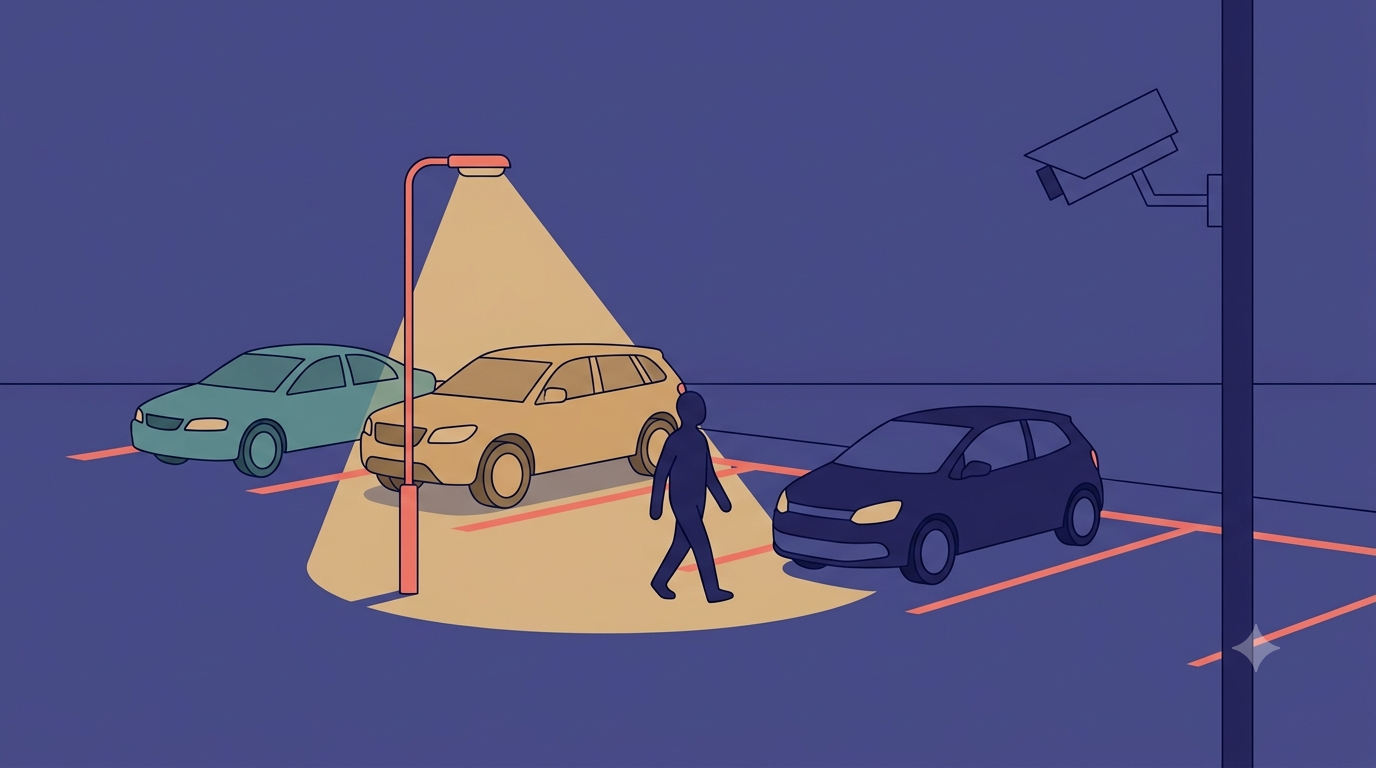
A second systematic review, published in 2019 and covering forty years, identified 80 evaluations of CCTV, of which 76 held enough data to be pooled.
The overall result was that crime fell by approximately 13 per cent in areas with CCTV compared with control areas, which the reviewers describe as a modest but significant crime prevention effect.
It is this 13 per cent that is usually quoted as proof that cameras work. But a pooled figure of this kind is an average across every setting mixed together, and looking at each setting separately shows that cameras work only in some of them.
The clearest effect is in car parks, where crime fell by approximately 37 per cent across eight studies.
In city centres, the setting with the largest number of studies at 33, the result was too small to conclude there was a real effect. The same was true in housing complexes and on public transport.
Split by crime type, violent crime across 29 studies showed no conclusive effect, and disorder across six studies showed none either.
One finding deserves particular attention. Split by country, the effect in the United Kingdom was clear, while the effect in the United States could not be concluded to exist, which the reviewers call particularly noteworthy given that this review added 20 more evaluations conducted in the United States.
What this tells us is that CCTV is not a measure that works the same way everywhere. It is a measure that performs well in one kind of setting and barely performs at all in another.
Source: https://prohic.nl/wp-content/uploads/2020/11/2020-04-01-CCTVReviewPizaetal.2019pdf.pdf
What Makes Cameras Work or Fail
The more useful question than whether cameras work is which kind of camera scheme works, and this review answers it very directly.
The first condition is that somebody must actually be watching. The reviewers separated schemes into two kinds: those where staff watch live images and can respond the moment they see something, and those where cameras simply record for review after an incident has already happened.
The difference is stark. Across 54 actively monitored schemes, crime fell significantly. Across 11 passively monitored schemes, no effect could be concluded at all.
The second condition is that other measures must accompany the cameras. Schemes using CCTV alone, 36 of them, showed no conclusive effect. Schemes pairing it with one other measure, 26 of them, showed none either. Schemes combining it with several other measures at once, 14 of them, saw crime fall by approximately 34 per cent.
The reviewers state the conclusion plainly: this finding provides evidence against the use of CCTV as a stand-alone tactic, and rather than relying on conspicuous camera presence, public safety agencies should employ active camera monitoring to identify and address incidents of concern proactively.
Put simply, a camera nobody is watching is not a crime prevention measure. It is a recording device for looking at afterwards.
Source: https://prohic.nl/wp-content/uploads/2020/11/2020-04-01-CCTVReviewPizaetal.2019pdf.pdf
Lessons for Thailand
Bangkok has already invested heavily. In July 2025 the Director of the Bangkok Metropolitan Administration's Department of Traffic and Transport stated that the city's CCTV cameras total 65,015 units across 16,623 locations, and explained that of the 2.3 billion baht spent over the previous three years, more than 80 per cent went on maintenance.
Source: https://www.nationthailand.com/thailand/bangkok/40052550
Setting that figure alongside the research produces four questions worth asking.
First, how many of those cameras has somebody actually watching live images? This is the single most decisive variable in the research, and systems that merely record were not found to reduce crime.
Second, are the cameras placed where the evidence says they work? The clearest effect is in car parks, while city centres, where expectations are highest, produced no conclusive effect.
Third, are other measures being implemented alongside them? Cameras used alone showed no effect, while cameras combined with several other measures performed best.
Fourth, if the goal is reducing violent crime, the evidence supports neither cameras nor lighting, since for neither could an effect on violent crime be concluded. What both do reasonably well is property crime.
Finally, there is no published Thai evaluation measuring the effect of street lighting or CCTV on actual crime, and neither of the two systematic reviews above includes a single study from Thailand.
That gap would not be hard to close. Whenever an installation goes into an area, all that is required is to record the crime figures for that area before and after, and compare them with a similar nearby area where nothing was installed. That alone would show what the money bought.
References
Cozens, P., & Love, T. (2015). A review and current status of Crime Prevention Through Environmental Design (CPTED). Journal of Planning Literature, 30(4), 393-412. https://prohic.nl/wp-content/uploads/2021/02/166-15feb2021-CPTEDReview.pdf
Nation Thailand. (2025, July 12). Bangkok defends 2.3 billion baht CCTV spending, says over 80% went on maintenance. https://www.nationthailand.com/thailand/bangkok/40052550
Piza, E. L., Welsh, B. C., Farrington, D. P., & Thomas, A. L. (2019). CCTV surveillance for crime prevention: A 40-year systematic review with meta-analysis. Criminology & Public Policy, 18(1), 135-159. https://prohic.nl/wp-content/uploads/2020/11/2020-04-01-CCTVReviewPizaetal.2019pdf.pdf
Welsh, B. C., Farrington, D. P., & Douglas, S. (2022). The impact and policy relevance of street lighting for crime prevention: A systematic review based on a half-century of evaluation research. Criminology & Public Policy. https://prohic.nl/wp-content/uploads/2022/05/389-StreetLightingEffectivenessPreventingCrimeSystematicReview.pdf
Good knowledge should not stay in the library. It should be used to build a safer world.
Follow us at www.crimesci.com
Contact info@crimesci.com
#HubofKnowledge #CenterforCrimeScience #CrimeScienceWeekly
#วิทยาการอาชญากรรม #CPTED #กล้องวงจรปิด #เมืองปลอดภัย