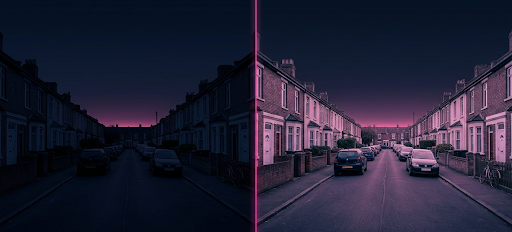
Reviews of the evidence have found improved street lighting associated with reductions in crime, but one part of that pattern resists explanation: the reductions also appeared during daylight. If lighting worked by making things easier to see, daytime figures should not have moved. This study therefore asks a cleaner question: at the same time of day, is the risk of crime higher in darkness than in daylight? The method is to pick an hour that falls in darkness in winter but remains in daylight in summer, such as 18:30 to 19:29 in Sheffield, and compare crime counts in that same hour across the two conditions, which removes time of day as a confounding factor. Season still brings its own differences in weather and school holidays, so a control hour that stays in daylight all year, such as 14:00 to 14:59, is compared alongside it, to show whether the change comes from darkness or from the season. The authors analysed ten years of crime records from South Yorkshire Police in the United Kingdom, as a registered report, meaning the hypotheses and analysis plan were published before the data were seen. Overall risk was higher after dark, but not for every category of crime and not in every area.
Research Objectives
- Test whether the overall risk of crime at the same time of day is higher in darkness than in daylight.
- Test whether the effect of darkness varies by category of crime.
- Test whether the effect of darkness varies by geographical area.
- Address the limitation of earlier work, which relied on aggregated crime data and therefore had to simplify the treatment of crime types and locations, by obtaining individual crime records directly from a police force.
Methodology
- Darkness was defined as the sun's altitude being at or below -6 degrees, the transition between civil and nautical twilight, with an average illuminance of 2.33 lx. Daylight was defined as the sun's altitude being at or above 0 degrees, with an average illuminance of 509 lx.
- Three case hours were paired with three control hours: 17:30-18:29 with 13:00-13:59, 18:30-19:29 with 14:00-14:59, and 19:30-20:29 with 15:00-15:59. Odds ratios were then calculated, a value significantly above 1 indicating greater risk after dark than in daylight.
- Data came from the crime recording systems of South Yorkshire Police, covering Barnsley, Sheffield, Rotherham and Doncaster, for crimes recorded between 1 January 2010 and 31 December 2019, following the Home Office counting rules for recorded crime and the National Crime Recording Standards.
- 43,302 crimes were extracted; crimes occurring on dates when the case hour was partly in twilight were then excluded, leaving 34,618 for the main analysis across 14 crime categories, with p-values corrected using the Holm-Bonferroni method to account for multiple tests.
- As a registered report, the design guards against constructing hypotheses after seeing results: the two authors who developed the hypotheses and analysis plan had no access to the data, wrote the analysis script in R, and passed it to three co-authors who are South Yorkshire Police employees to run against the records, with the analysis plan published before any data were accessed.
Key Findings
- The combined odds ratio across all 14 crime categories was 1.30 (95% CI: 1.24-1.35, p < 0.001), indicating that darkness significantly increases the risk of crime overall.
- Five of the 14 categories had odds ratios significantly above 1: burglary at 2.58 (2.24-2.97), vehicle offences at 2.00 (1.73-2.33), robbery of a person at 1.87 (1.33-2.62), bicycle theft at 1.68 (1.26-2.24) and criminal damage at 1.55 (1.39-1.73).
- Categories showing no significant difference included violence with injury (0.97), violence without injury (0.91), theft from the person (0.83) and shoplifting (1.16); the first three fall below 1 but not to a significant degree.
- The effect also varied spatially. Of the 172 Middle Super Output Areas in South Yorkshire, 25 had odds ratios clearly above 1, with values across all areas ranging from 0.45 to 7.00.
- The authors note that confidence intervals for many areas were wide because crime counts per area were small, and that they chose not to calculate odds ratios per crime category within each area, since very low counts could potentially identify victims.
Recommendations
- The results suggest street lighting could have a mediating role on the risk of crime, though the authors state this requires further confirmation.
- Future work should investigate how the presence of lighting and its characteristics, such as illuminance and uniformity, influence the risk of crime, so that lighting can be optimised.
- Lighting design must be balanced against its negative impacts, which the authors identify as energy and carbon costs, light pollution, and harmful effects on flora and fauna.
- Future work should also account for displacement, since previous work suggests light conditions in one area can influence crime in adjacent areas.
- The authors propose that the method used here could serve as a metric for the effectiveness of lighting in reducing risk after dark, and for assessing displacement between adjacent areas.
Key Takeaways
- Darkness clearly raises the risk of property crime, with burglary roughly two and a half times more likely after dark than in daylight, while no effect appeared for violent crime. This indicates which crime types lighting investment is best aimed at.
- The strength of this study lies in publishing the hypotheses and analysis plan before seeing the data, and in separating the people who set the hypotheses from the people with data access, so the findings cannot be accused of selective analysis.
- For Thailand the findings inform decisions about what problem street lighting is being installed to solve. This connection is our own; the study covers the United Kingdom, where the difference in day length between seasons is considerably greater than in Thailand.
References
Uttley, J., Canwell, R., Smith, J., Falconer, S., Mao, Y., & Fotios, S. (2025). Does darkness increase the risk of certain types of crime? A registered report article. PLOS ONE, 20(6), Article e0324134. https://doi.org/10.1371/journal.pone.0324134
Full text (Open Access): https://journals.plos.org/plosone/article?id=10.1371/journal.pone.0324134